
Postpartum Urinary Incontinence Treatment in UAE, Ajman | Dr. Zahra Jahanabadi


Postpartum urinary incontinence in UAE, Ajman affects roughly one in four women after childbirth. It means leaking urine without meaning to during the weeks and months after delivery. Most often it appears as postpartum stress incontinence: a leak when you cough, sneeze, laugh or lift your baby. Some women instead feel sudden urgency, and many live with a mix of both.
The numbers are bigger than most people expect. A 2023 systematic review found that about 26% of mothers develop urinary incontinence after giving birth (Dai et al., 2023). A separate review of pregnancy and postpartum studies reported that around one third of women still have symptoms at three months postpartum (Moossdorff-Steinhauser et al., 2021).
I am Dr. Zahra Jahanabadi. A female urologist at Thumbay University Hospital in Ajman. I help women manage urinary leakage after pregnancy and childbirth with respectful care and clear treatment plans.
The type of leakage matters because each pattern needs a different approach. I want you to know two things. It is common. And it is treatable, with care that takes you seriously.
The Fourth Trimester Leak
There is a sentence I hear: “It’s normal to leak after having a baby, isn’t it?”
My answer is both yes and no.
Yes, it is common. Roughly one in four new mothers deal with postpartum urinary incontinence in UAE, Ajman.
No, it is not something to simply accept. Common does not mean inevitable. Common does not mean untreatable. And common certainly does not mean you should spend time planning every outing around the nearest bathroom.
Many women are told by friends, family or even well-meaning doctors that leaking is simply part of motherhood. For some it does settle in the early months. But here is the part that rarely gets said out loud: incontinence that lingers beyond six months hardly ever disappears on its own.
A patient I remember: a mother of a four-month-old came to me after months of being told her leaking was “normal” and would resolve. A careful look showed stress incontinence with urethral hypermobility. We started supervised pelvic floor training and fitted a pessary. Within weeks she was carrying her baby up the stairs without a second thought.
The message of this page is simple. You do not have to wait and hope. If you leak after childbirth, you deserve a proper check and a real treatment plan. Not a shrug and a reminder that “it’s normal”.
How Childbirth Affects Bladder Control
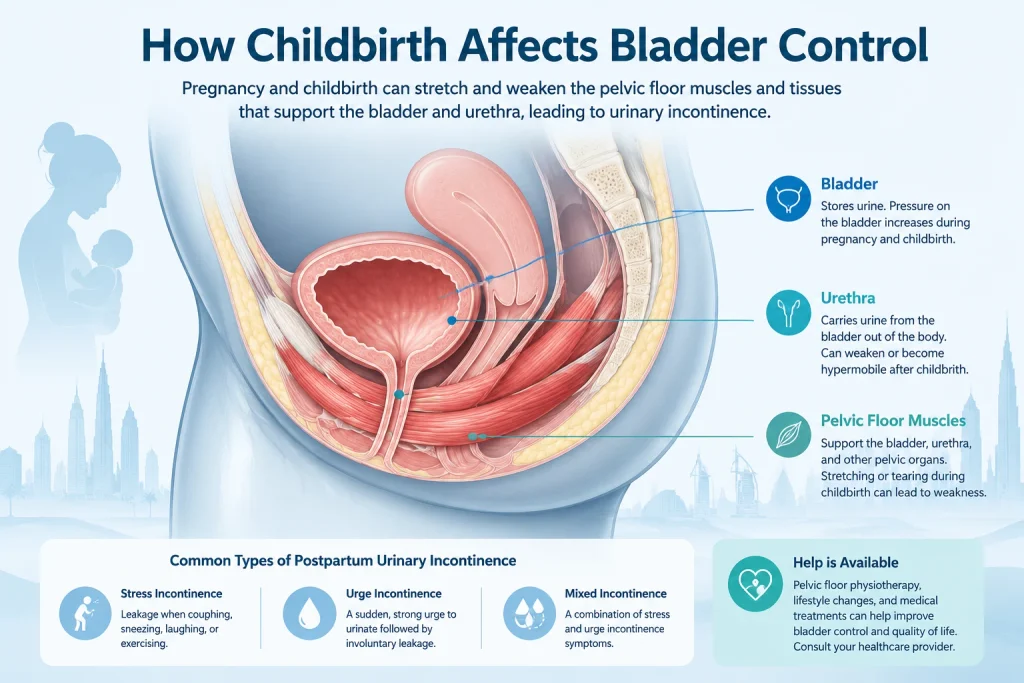
Pregnancy places extra weight on the bladder and pelvic floor. During vaginal birth, the pelvic floor stretches to allow the baby to pass. Muscles, nerves and connective tissue can all be affected.
The risk of postpartum stress incontinence rises with several factors:
- Vaginal delivery
- Forceps or vacuum assistance
- A larger baby
- Several previous births
- Higher maternal age
- Higher body mass index
- Leakage during pregnancy
- A history of pelvic floor weakness
A caesarean birth does not remove every risk. Pregnancy itself places pressure on the bladder and pelvic floor. Some women also develop urgency symptoms after birth.
In Ajman, a retrospective study at Thumbay University Hospital reviewed 210 women with urinary incontinence between 2021 and 2026. Stress incontinence was the most common subtype at 40.5%. Urgency incontinence accounted for 32.4%. Mixed incontinence accounted for 27.1%.
This study included women attending a tertiary hospital. It was not limited to new mothers. I therefore use it as local context rather than as a direct estimate for postpartum women.
The Breastfeeding-Bladder Connection
One of the questions I hear most from new mothers is whether breastfeeding affects bladder control. It can, and the reason is worth understanding.
The hormonal mechanism
During lactation, prolactin rises and estrogen falls. Doctors call this state lactation related hypoestrogenism. Lower estrogen reduces urethral closure pressure, the seal that keeps urine inside until you decide otherwise. Research links breastfeeding with urinary incontinence in roughly 30% of women, likely for this hormonal reason.
What this means for you
If you breastfeed and you leak, you are not imagining the connection. The hormonal world of lactation is different from pregnancy, and it changes how the urethra and pelvic floor behave.
This is emphatically not a reason to stop breastfeeding. It is a reason to have your leaking evaluated within your breastfeeding journey rather than ignored until weaning.
The Real Timeline of Postpartum Recovery

The six-week postnatal visit is an important checkpoint. It is not a deadline for every woman to feel fully recovered.
Some women improve during the first few months. Others continue to leak during exercise or daily activity. Systematic reviews have reported urinary incontinence in about one-third of women at three months after birth. Weekly leakage affects around 12%. Daily leakage affects about 3%.
Symptoms that continue beyond six months deserve a focused review. Long-term studies have found that many women who still have incontinence at three months continue to report symptoms years later.
I encourage you to seek help sooner when:
- Leakage limits walking or exercise
- You avoid leaving home
- You use pads every day
- You leak during intimate moments
- You feel pelvic heaviness
- You have difficulty emptying your bladder
- You experience repeated urine infections

Why Supervised Pelvic Floor Training After Birth Matters
You have almost certainly heard of Kegels. What you may not have heard is that doing them correctly is harder than it sounds, and doing them wrong can quietly stall your recovery.
Why supervision matters
Unsupervised Kegels are frequently performed incorrectly. Some women bear down instead of lifting, which pushes pressure the wrong way. Others squeeze abdominal muscles instead of pelvic floor muscles and never train the right tissue. Supervised pelvic floor muscle training (PFMT) fixes this with proper checking, feedback and progression.
What supervised PFMT involves
- A careful review of pelvic floor muscle function, looking at strength, endurance and coordination
- Biofeedback to confirm your technique is correct
- A structured progressive program, typically eight weeks or longer
- Functional training for real life: lifting the baby, coughing, returning to exercise
What the guidelines say
Treatment guidance is clear that PFMT delivered by a trained health professional should be offered to women after delivery, and supervised PFMT stands as the first line conservative treatment for postpartum incontinence.
When to start
Usually around six weeks after delivery, once your obstetrician clears you, though timing can be changed to your recovery.
Postpartum Urinary Incontinence Treatment UAE and Ajman

Leaking changes far more than your clothes. It alters your workouts, disrupts your rest, and turns simple outings into a hunt for the nearest bathroom.
Treatment depends on the type and severity of incontinence. Options may include:
- Structured pelvic floor rehabilitation
- Bladder training
- Fluid and caffeine adjustment
- Treatment for constipation
- Vaginal support with a pessary
- Medication for selected urgency symptoms
- Injection treatment for an overactive bladder
- Nerve stimulation
- Surgical support for suitable cases
Surgery is not the first. When stress incontinence remains troublesome despite rehabilitation, I discuss procedures such as a sling. I explain the expected benefit and the possible risks before any decision.
Your recovery plan needs to fit your actual life. We build it around your breastfeeding goals, future family plans, and whatever option feels most comfortable for you.

Why Choose a Female Urologist for Postpartum Incontinence in UAE, Ajman?
Intimate care deserves a doctor you feel comfortable with. For many UAE mothers that means a woman, and I built my career around exactly that need.
Comfort and trust
Sensitive pelvic examinations and honest conversations are easier with a female specialist who has spent 18 years caring for women and who understands the postpartum experience firsthand.
Understanding of childbirth related injury
I look at your delivery story the way a urologist should: instrumental delivery, perineal tears, a long second stage, breastfeeding hormones. These details shape your diagnosis and your treatment.
Comprehensive care
You have the full spectrum under one roof, from supervised pelvic floor training to advanced diagnostics and surgical options when they are genuinely needed.
Cultural sensitivity
Many mothers across the Emirates prefer a female urologist for intimate concerns. At Thumbay University Hospital we offer a respectful, judgment free and family centered environment where your privacy comes first.
Frequently Asked Questions

It can. Concerns about leakage, pelvic pressure, dryness, pain, or body confidence may affect intimacy. These symptoms can be discussed confidentially and may be treatable.
Yes. Even a small leak can be a sign that your pelvic floor needs support. If it keeps happening or affects your daily routine, a doctor can help identify the cause and suggest practical next steps.
Pregnancy itself puts pressure on the bladder and pelvic floor. A caesarean birth does not prevent every cause of postpartum leakage, so persistent symptoms still deserve attention.
A pad can help you feel more comfortable while symptoms are being addressed. Change it regularly and seek advice if you develop skin irritation, pain or unusual discharge.
Pregnancy and childbirth can change pelvic floor symptoms. If you are planning another pregnancy, mention it during your appointment so treatment choices can take your plans into account.
Bring a list of your medicines and a brief note about when leakage happens. If you have one, bring a record of your birth and recovery details. A short bladder diary can also be useful.
Book Your Consultation: Reclaim Your Confidence After Childbirth
Postpartum urinary leakage is common. It is treatable. You deserve care that takes your symptoms seriously.
I invite you to book a consultation at Thumbay University Hospital in Ajman, UAE. After looking closely at your delivery history and current symptoms, we will figure out the best next step together.



You can submit the first comment for this post using the form above.