
Urinary Tract Infection Doctor UAE, Ajman : Expert Care


If you’ve had more than one urinary tract infection this year, you already know the cycle — the symptoms, the antibiotics, the brief relief, and then, weeks or months later, the same symptoms returning. You’re not imagining it. And you’re not alone.
I’m Dr. Zahra Jahanabadi, a Consultant Urologist specialising in female and functional urology in UAE, Ajman. I’ve spent many years helping break this cycle — not by prescribing yet another course of antibiotics, but by understanding why the infections keep coming back.
If you keep getting UTIs, the most important question is not “Which medicine should I take?” but “Why is this happening repeatedly?”
The Role of a UTI Specialist : Why You Need More Than a Prescription
If you have had several UTIs, you have probably received more than one prescription. You might have seen a general practitioner. Perhaps you went to a walk-in clinic or booked a quick telehealth appointment. The symptoms eased, only to return.
A UTI specialist in the UAE can take a closer look at why that keeps happening.
While a general practitioner often treats the symptoms you have today, a urologist looks for the reason they keep coming back. The questions include:
- Did a urine test confirm an infection?
- Is the same organism causing each episode?
- Could something else be causing the symptoms?
- Does the bladder empty fully?
- Is the pelvic floor playing a part?
- Could hormonal changes be involved?
- Are there signs of stones or prolapse?
- Has past antibiotic use changed the pattern?
As a Consultant Urologist with more than 18 years of experience, I look at the full picture. The aim is to understand why the symptoms return rather than treat only the latest episode.
What a UTI Specialist Does Differently

A specialist looks beyond the latest flare-up. They review your symptoms and past urine cultures to check whether infection is truly the cause. They can also check how well your bladder empties and look for factors such as hormonal changes or pelvic floor problems.
The goal is a plan that fits your situation. That includes using antibiotics only when needed and finding ways to reduce future episodes.
If you have had two UTIs in six months or three in 12 months, it is worth seeking specialist advice instead of repeating short consultations.
GP, Gynecologist, or Urologist? Find the Right UTI Doctor
One of the most common questions I hear from patients is: “I have a UTI — should I see a GP, a gynecologist, or a urologist?” The honest answer is: it depends on your situation.
When a General Practitioner is appropriate:
- First-time, uncomplicated UTI in an otherwise healthy woman
- Mild symptoms with no red flags
- A short course of antibiotics fully resolves symptoms
Situations Where a Gynecologist Can Help:
- UTI symptoms linked to vaginal dryness, atrophy, or hormonal changes
- Post-menopausal recurrent UTIs with signs of genitourinary syndrome of menopause (GSM)
- Symptoms that overlap meaningfully with gynecological conditions
When a Urologist is the right choice:
- Recurrent UTIs which is 2 or more in 6 months, or 3 or more in 12 months
- Symptoms that don’t improve after appropriate antibiotic treatment
- Urine cultures that return negative despite persistent urinary symptoms
- Blood in the urine alongside UTI symptoms
- Suspected structural abnormality, kidney stones, or bladder dysfunction
- Pregnancy with a complicated UTI
The bottom line: if your UTIs are recurrent, if common treatments aren’t working, or if complicating factors are present — a urologist is the specialist you need. And if you prefer a female urologist for comfort and understanding, that is a valid and important preference. It shapes the entire consultation.
For guidance on the treatment side of UTIs, see our Urinary Tract Infection treatment guide.
When to See a Urinary Tract Infection Doctor in Ajman, UAE

One UTI does not usually call for a urologist. If infections keep returning or the cause of your symptoms remains unclear, a specialist can help you find out what is going on.
UTIs that keep coming back
burning and urgency can feel like a UTI even when bacteria are not the cause. A specialist reviews your symptoms alongside your urine test results before deciding what to do next.
Symptoms that do not go away
If symptoms persist after treatment or return soon afterward, another prescription is not always the answer. The doctor can check whether the infection was resistant to the medicine and whether your bladder empties properly.
Stones and pelvic floor problems can also cause ongoing symptoms.
Repeated negative urine cultures deserve the same care. They can point to a condition that feels like a UTI without being an infection. A specialist can look at how the urine samples were collected and explore other causes.
When further checks matter
A urology review is especially useful if there is concern about a stone or blockage. It can help when you have trouble emptying your bladder or have had repeated kidney infections.
Blood you can see in your urine should be checked
Visible blood needs medical attention even if you think a UTI is the cause. If it remains after treatment or returns later, further investigation is important.
If you are pregnant and have symptoms of a complicated UTI, seek immediate medical care.
What a Urinary Tract Infection Doctor Actually Does

When a patient sits across from me for the first time, I am not thinking about which antibiotic to prescribe. I am building a picture.
A thorough specialist consultation for recurrent UTIs includes:
Comprehensive history
Your symptom pattern, the frequency and character of infections, every antibiotic you’ve taken and whether it worked, your sexual health history, hormonal status, and obstetric history — all of this shapes what I look for.
Physical examination
A gentle pelvic examination can reveal physical changes that affect your symptoms and help shape your care plan.
Targeted urine testing
Urinalysis with microscopy and urine culture with sensitivity testing provide more reliable information than a dipstick test alone. These tests identify the specific organism and show which antibiotic is most likely to work.
Post-void residual (PVR) measurement
A simple ultrasound scan after urination that tells us whether your bladder is emptying fully. Residual urine is a reservoir for bacterial growth.
Urodynamic testing when indicated
For patients whose symptoms suggest bladder dysfunction rather than straightforward infection, urodynamic studies assess how the bladder fills, stores, and empties.
Cystoscopy when structural pathology is suspected
A direct view inside the bladder, performed when imaging or symptoms suggest an abnormality.
Imaging
Ultrasound or CT urography when kidney stones, upper tract involvement, or structural issues are a possibility.
This is not a five-minute appointment. It is a clinical investigation. You will leave with a diagnosis — or at minimum, a clear plan to reach one.
Red Flags That Demand Immediate Attention
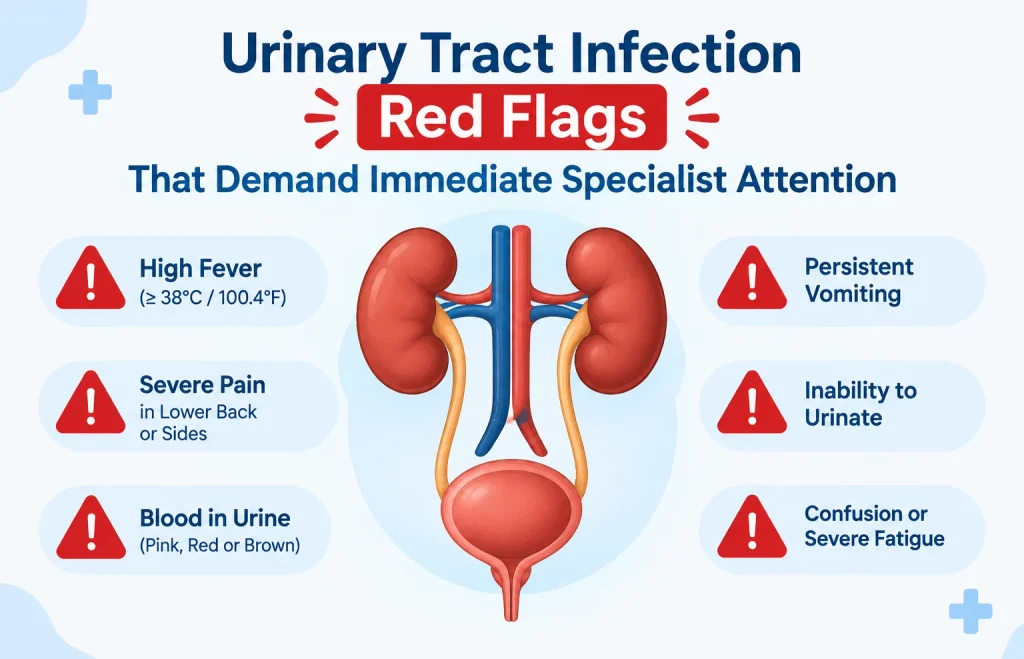
Do not wait for a routine appointment if you have urinary symptoms alongside any of these signs:
- Fever or chills
- Pain in your back or side
- Vomiting that makes it hard to keep fluids down
- Blood you can see in your urine
- Trouble passing urine
- New confusion
- Severe weakness or symptoms that worsen quickly
Seek medical advice right now if your symptoms have not improved after 48 hours of prescribed treatment. If you are pregnant and have UTI symptoms, contact a healthcare professional immediately.
These signs can point to a kidney infection or another serious problem. If you feel very unwell or your symptoms are getting worse quickly, seek emergency care rather than waiting for a specialist appointment.

10 FAQ’s When Visiting UTI Doctor in UAE, Ajman
When urinary symptoms keep returning, it helps to know what is causing them before trying another treatment. These are practical questions to bring to your consultation.
Burning and urgency do not always mean infection. I review your previous test results and recommend a urine culture when it would help confirm the cause.
For symptoms that keep returning, a culture can show whether bacteria are present and which antibiotic is likely to work. A dipstick cannot provide that level of detail.
The infection could still be present. Your symptoms could also have another cause. I would consider whether a repeat urine test is needed before changing your medicine.
I would ask how often you go and whether the urge wakes you at night. This helps us work out whether the pattern fits an infection or a bladder problem.
If your stream is weak or you need to return to the toilet soon afterward, I can check how much urine remains in your bladder. This is called a post-void residual test.
This is a common pattern and should be discussed openly and without embarrassment. I would first establish whether these episodes are confirmed infections or whether irritation, pelvic floor tension, or another cause may be involved. We can then consider prevention measures.
Another course is not always the answer. We’ll look at what you’ve already taken and how you responded before deciding what comes next.
The best approach depends on what is driving your symptoms. If tests confirm repeated infections, we can look at practical prevention steps and discuss whether a treatment such as vaginal oestrogen is suitable for you.
If an underlying bladder problem is involved, addressing that could make more difference than another round of antibiotics. We’ll also agree on what to do if symptoms return.
Book Your Consultation With Dr. Zahra Jahanabadi
If urinary symptoms keep coming back, it is time to look beyond the next prescription. Dr. Zahra Jahanabadi can help find out what is causing them and discuss a plan that fits your needs.
Book through Thumbay University Hospital or our online form. Bring any previous urine test results and tell the team if you are pregnant. If you have severe symptoms, seek urgent medical care rather than waiting for an appointment.





You can submit the first comment for this post using the form above.