
Stress Urinary Incontinence Treatment in UAE, Ajman | Dr. Zahra Jahanabadi


A small leak when you cough. A sudden damp feeling during exercise. A pad in your handbag before you leave home.
Many women quietly adjust their lives around these moments. They stop running. They avoid jumping. They plan bathroom visits before social events. Some even reduce water intake because they fear leakage.
Stress urinary incontinence is common. It is also treatable. As a specialist in female and functional urology, I help women understand why urine leakage occurs and which treatment is most appropriate.
If you are looking for stress urinary incontinence treatment in UAE, AjmanI offer a thorough evaluation and care designed around each patient’s needs at the Center for Urology at Thumbay University Hospital in Al Jurf, Ajman.
What Is Stress Urinary Incontinence?
Stress urinary incontinence means leaking urine when physical pressure is placed on the bladder.
You might notice a leak when you cough. It can also happen during a run. For some people, even standing up quickly is enough to trigger it.
The word “stress” refers to physical pressure on the bladder. It does not mean emotional stress.
A leak happens when the pelvic floor and urethra do not provide enough support during movement. While childbirth can weaken that support, menopause can also play a part, and in some people the change develops gradually with age.
Sometimes the reason is not clear. A careful check can help you understand what is happening.
Why Stress Incontinence Is More Common Than You Think

Stress urinary incontinence affects millions of women worldwide, yet it remains one of the most under-discussed issues in women’s health. A collaborative review in European Urology described this condition as “underdiagnosed and undertreated, leading to a substantial burden on health care systems and individuals alike.”
In my clinic I hear the same quiet phrases again and again:
- I shouldn’t be leaking at my age.
- It’s just what happens after having babies.
- What if it’s something serious?
- I’ll just wear a pad and hope it goes away.
Here is the clinical reality. Stress incontinence is common but not normal. The risk factors are well documented, including childbirth, rising age, obesity, and pelvic organ prolapse. Up to 46% of women experience it at some point, so if this is happening to you, you are far from alone.
What I tell every patient is this. You don’t have to live with leakage. You don’t have to plan your life around bathroom access. There is a way forward, and it starts with a conversation.
Why Does Stress Incontinence Happen?
Your bladder and urethra are held in place by a hammock of pelvic floor muscles and connective tissue. When that support weakens, the whole closure system struggles under pressure.
The most common factors that weaken it include:
- Pregnancy and vaginal childbirth, the single most significant risk factor for many women
- Increasing age, as tissue naturally loses strength
- Obesity, which raises pressure inside the abdomen every single day
- Chronic coughing from smoking, asthma, or COPD
- Chronic constipation, where years of straining strain the pelvic floor
- High-impact exercise such as running and jumping
- Previous pelvic surgery, including hysterectomy
- Genetic connective tissue weakness, often visible in a family history
- Postmenopausal estrogen deficiency, which thins and weakens the surrounding tissue
Very often several of these combine. A woman who had two vaginal deliveries, works in a job with heavy lifting, and has entered menopause carries far more risk than any single factor alone. That is why I, as a female urologist, always take a full history before recommending anything.
Is Stress Urinary Incontinence Normal After Childbirth?
Urine leakage is common during pregnancy and after childbirth. Pregnancy puts extra pressure on the pelvic floor, while vaginal delivery can stretch or injure the tissues that support the bladder. But being common does not mean you have to live with it.
For some women, leakage improves in the first few months after delivery. For others, it continues during activities such as exercise. You might also notice it when you cough or during intimacy. If leaks are affecting your confidence or keeping you from doing things you enjoy, it is worth getting them checked.
Treatment often starts with guided pelvic floor exercises. If the leakage continues, your doctor can talk through other options based on your symptoms and the findings from your check-up.
Stress Incontinence Treatment Options in Ajman
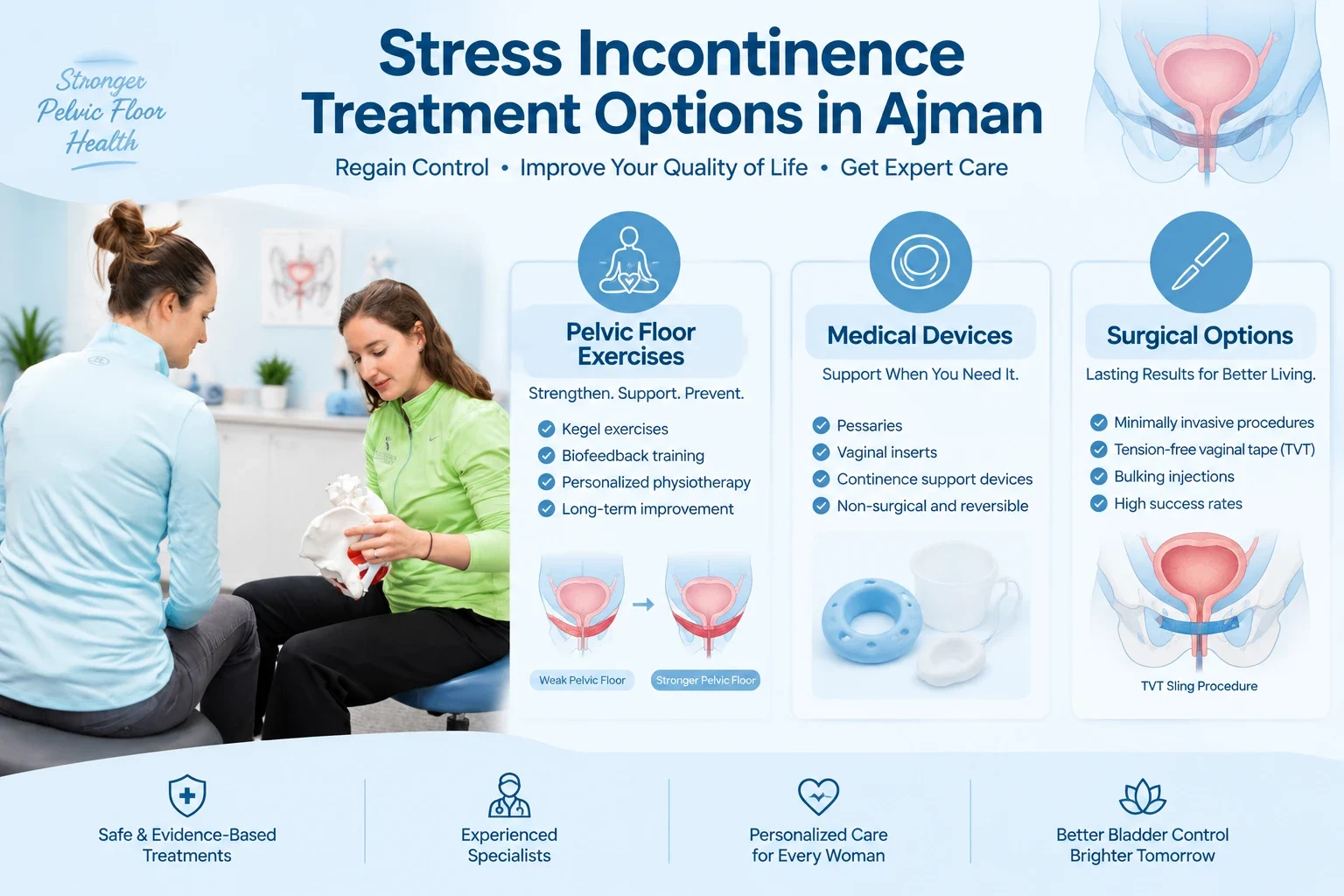
For many women, leaking during everyday activities builds up quietly over time until it starts shaping the choices they make.
Something as routine as going to a fitness class or lifting groceries becomes something to think twice about. That shift is worth addressing, and there are real treatment options available.
Pelvic floor retraining with a specialist
This is often the first treatment offered. A supervised program helps you learn how to use the right muscles and build strength over time. It can be especially useful if your symptoms are mild to moderate or began after childbirth.
Daily habits that take the pressure off
Small practical shifts can do more than you’d expect. Chronic straining from constipation puts extra load on your pelvic floor every single day.
Drinking too much too fast before bed sets you up for nighttime trouble. Carrying extra weight increases abdominal pressure.
High-impact exercise without the right internal support can make things worse before they get better.
None of these changes will solve stress incontinence on their own but they give everything else a fighting chance.
Continence pessary
A continence pessary is a device placed in the vagina to help support the urethra. It can be an option if you want to avoid surgery or mostly leak during exercise.
It’s also a popular pick for anyone who wants relief without committing to something permanent.
Urethral bulking treatment
Urethral bulking involves injecting a material around the urethra to help it close more effectively. Bulkamid is one example used to treat stress urinary incontinence in women.
This less invasive option suits some patients, but results differ from person to person. The improvement can also change over time. Some women need another injection or choose a different treatment later.
Mid-urethral sling procedures
A sling is a narrow strip of material placed under the urethra during surgery. It acts like a hammock that kicks in during any moment of physical strain.
This method works well for some women, but it is still surgery. We would talk through the potential benefits and risks before you decide, including recovery and other available options.
Less common surgical options
If these options are not suitable, another procedure could be worth considering. That decision depends on your medical history and any previous surgery. We would also look at how your urethra functions and what you want from treatment.
You shouldn’t walk away from an appointment feeling like you were handed a script. The whole point is to understand what’s actually happening and work out together what makes sense to try first.
Read more: Urinary Tract Infection Doctor UAE, Ajman
Beyond Kegels: Supervised Pelvic Floor Training

When I mention pelvic floor exercises, patients often tell me, “I’ve tried Kegels. They didn’t work.”
Often, they have been practicing on their own without knowing whether they are using the right muscles. Doing the exercises regularly is important, but technique matters too.
NICE recommends a supervised pelvic floor muscle training program lasting at least three months as a first treatment for women with stress urinary incontinence.
Supervised pelvic floor muscle training involves:
- Checking how your pelvic floor works: Can you tighten the muscles and then fully relax them? Are you using the right muscles?
- Following a progressive program: Your exercises change as your strength and control improve.
- Using biofeedback when appropriate: Sensors can help show whether you are engaging your pelvic floor correctly.
- Coming back for follow-up: What works in the first week might need adjusting later.
- Practicing for daily life: You learn how to engage your pelvic floor before a cough or when lifting something.
A 42-year-old mother of two came to me after trying Kegels on her own for two years without improvement. During her examination, we found that she was tightening her abdominal muscles instead of her pelvic floor. After twelve weeks of supervised training with biofeedback, she reported that she no longer leaked during gym classes.
If Kegels have not helped you, it does not necessarily mean pelvic floor training cannot help. Having someone check your technique can make the next step much clearer.

Why Choose a Female Urologist for Stress Incontinence Treatment?
Choosing a specialist for something as sensitive as urinary leakage is a deeply personal decision. Many women in the UAE prefer the care of a female urologist, and I am proud to provide that comfort.
I encourage you to reach out if you notice:
- Leakage that interferes with daily life, exercise, or social plans
- Symptoms that do not improve after trying basic pelvic floor exercises
- A gradual worsening of leakage over time
- Mixed symptoms involving both stress and urgency
- Previous failed incontinence surgeries
- Significant pelvic organ prolapses accompanying your Stress incontinence
My services at Thumbay University Hospital offers a judgment-free, private environment where we can discuss your symptoms with the discretion you deserve.
Do not let embarrassment or doubt keep you from the life you enjoy. You deserve to move, exercise, and live with freedom. Contact us today to schedule your consultation.





You can submit the first comment for this post using the form above.