
Cystometry (CMG) in Ajman, UAE | Bladder Pressure & Capacity Evaluation


You’ve visited a female urologist in Ajman, UAE, and she has recommended cystometry (CMG). You’re likely wondering what the test can show and why it’s needed. I’m Dr. Zahra Jahanabadi, Consultant Urologist at Thumbay University Hospital. I use cystometry to study how the bladder stores fluid and how its muscle responds as it fills.
A cystometrogram, often shortened to CMG, records bladder pressure during filling. The procedure helps us understand overall bladder storage and muscle function. It is one part of urodynamic testing, not a substitute for every bladder investigation.
The purpose is straightforward. We want to understand what happens inside your bladder as it fills.
Focused Bladder Pressure and Capacity Evaluation
I often explain that the bladder is not simply a storage bag. Its wall contains the detrusor muscle, which should remain relaxed as urine collects and contract when it is time to empty. Cystometry helps us look at both how much the bladder holds and what pressure the muscle creates along the way.
During filling cystometry I look at four main features:
- Your bladder’s storage capacity.
- Your awareness of filling.
- The behavior of the detrusor muscle.
- How easily the bladder stretches without a sustained pressure rise.
An adult bladder often stores several hundred milliliters, but there is no single capacity that defines normal for every woman. A capacity number alone cannot tell us whether storage is safe or comfortable.
Imagine two women whose bladders each hold about 400 mL during testing. One has a relaxed bladder wall and steady pressure. The other develops rising pressure as the bladder fills.
Their capacities look alike, yet their bladder behavior is different. With neurological conditions in particular, pressure and compliance can matter for protecting the upper urinary tract, so results need individual interpretation.
What Exactly Cystometry Records as Your Bladder Fills
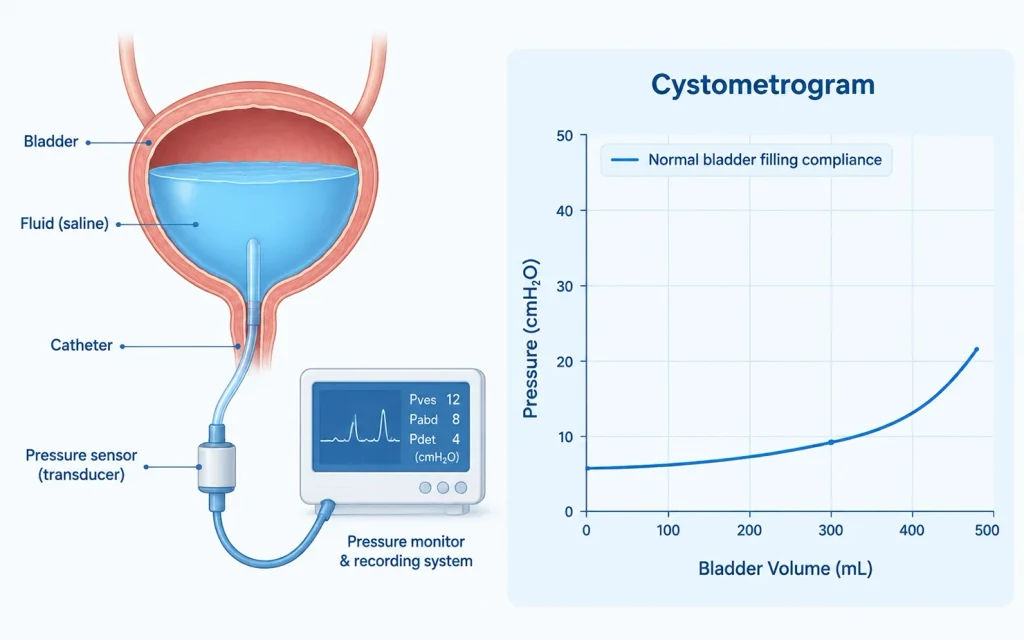
A bladder capacity test gives us more than a final volume. The relationship between sensation and pressure often provides the most useful information.
| Measurement | What we record | Why it matters |
| Bladder sensation | When you first notice filling and when the desire to urinate develops | Helps identify unusually early sensation or reduced awareness |
| Maximum cystometric capacity | The volume reached at the end of filling | Shows storage capacity under the conditions of the test |
| Detrusor activity | Involuntary muscle contractions during filling | Provides evidence of detrusor overactivity |
| Bladder compliance | The increase in volume divided by the rise in detrusor pressure | Shows how easily the bladder accommodates fluid |
| Leakage during testing | Whether urine escapes and what the pressure signals show at that moment | Helps distinguish leakage associated with stress from leakage during a bladder contraction |
First sensation of filling is the earliest point at which you notice fluid entering your bladder. It does not necessarily mean that you want to urinate.
First desire to void is the point at which you would normally consider passing urine but could comfortably wait. Strong desire to void describes a persistent desire that remains tolerable without fear of leakage.
Maximum cystometric capacity (MCC) is the volume reached when filling ends. The reason for stopping matters. Strong desire is one reason. Discomfort or a safety concern can also bring filling to an end.
These measurements need context. A single volume cannot establish the cause of urgency or diagnose bladder pain syndrome.
When I think is best to Recommend Cystometry for Women in Ajman
I recommend cystometry in Ajman (UAE) when its result is likely to answer a specific clinical question or influence a treatment choice. Examples like:
- Persistent or complex urgency, frequency or leakage when the cause is uncertain
- Suspected detrusor overactivity when symptoms have not responded as expected to initial care
- Neurological bladder concerns where pressure and storage behavior need closer review
- Voiding difficulty, retention or incomplete emptying when a pressure recording will help direct further investigation
- Selected women being considered for surgery for stress leakage or pelvic organ prolapse, when the findings could change planning
Cystometry is not routinely needed for every woman with uncomplicated leakage or a straightforward urinary infection. If you have symptoms of an active urinary infection, I would usually arrange urine testing and treat the infection before proceeding.

We also consider whether a patient can comfortably follow the instructions and whether a rectal pressure catheter is appropriate in the circumstances.
If a separate pressure-flow study is included you will also be asked to pass urine while pressure is recorded. That additional phase examines emptying rather than storage.
How Filling Cystometry Is Performed

It is understandable to feel uneasy about a catheter test. I explain each step before we begin, and you can ask us to pause at any point.
Follow the instructions given with your appointment. The visit sometimes starts with a urine flow test, so the team could ask you to arrive with a comfortably full bladder. Unless you have been told otherwise, do not empty your bladder just before arriving.
Conventional multichannel cystometry takes place in a clinical testing room. You remain awake because telling me what you feel is an important part of the test. Sedation is generally unnecessary.
The team cleans the area around the urethral opening and passes a thin catheter into the bladder. With your consent, a second small catheter is placed in the vagina or rectum to record abdominal pressure. Sterile fluid then flows into the bladder at a controlled rate while the equipment records pressure changes.
I ask you to tell me when you first notice the filling and when the urge becomes strong. There is no target volume you need to reach.
Tell us if you feel pain rather than trying to hold on. The team also records details of how the test was done, including the filling rate and your body position, so the results can be understood in context.
When Other Recording Is Considered
If the usual filling process does not bring on your symptoms, your doctor can ask you to cough or change position. These steps are chosen for a reason; the aim is not to put you through every possible maneuver.
When your symptoms do not match the clinic-based recording, your female urologist can consider ambulatory cystometry. This uses portable equipment to record bladder activity over a longer period as you go about ordinary activities.
Most patients do not need it. A conventional test that does not show overactivity does not necessarily rule out episodes that happen at other times.
Read more: Urodynamic test and bladder diagnostics
Reading the Cystometrogram
I review the pressure curves alongside the sensations you reported. I also consider whether the test reproduced the problem that brought you to the clinic.
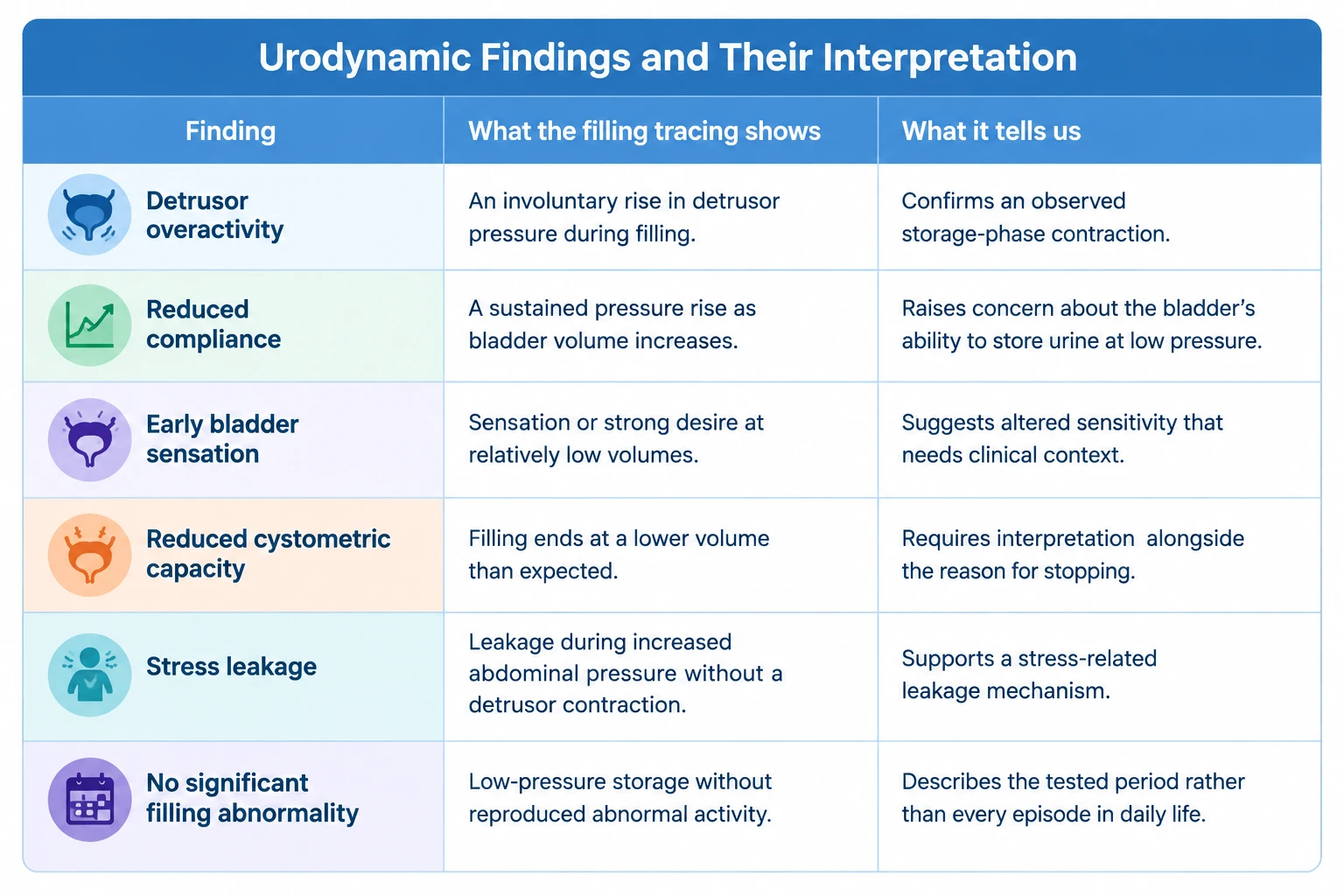
| Finding | What the filling tracing shows | What it tells us |
| Detrusor overactivity | An involuntary rise in detrusor pressure during filling | Confirms an observed storage-phase contraction |
| Reduced compliance | A sustained pressure rise as bladder volume increases | Raises concern about the bladder’s ability to store urine at low pressure |
| Early bladder sensation | Sensation or strong desire at relatively low volumes | Suggests altered sensitivity that needs clinical context |
| Reduced cystometric capacity | Filling ends at a lower volume than expected | Requires interpretation alongside the reason for stopping |
| Stress leakage | Leakage during increased abdominal pressure without a detrusor contraction | Supports a stress-related leakage mechanism |
| No significant filling abnormality | Low-pressure storage without reproduced abnormal activity | Describes the tested period rather than every episode in daily life |
Detrusor overactivity (DO) does not require a contraction greater than 15 cm H₂O. There is no fixed minimum contraction amplitude in the standard definition.
The older phrase uninhibited detrusor contractions also appear in some reports. Detrusor overactivity is the preferred term for the observed finding.
Overactive bladder and detrusor overactivity are related but different. Overactive bladder is a symptom-based diagnosis. Detrusor overactivity is a finding recorded during testing.
A woman can have troublesome overactive bladder symptoms without a contraction being captured during cystometry.
Similarly, a low capacity does not establish interstitial cystitis or bladder pain syndrome. Those diagnoses depend on a wider clinical picture.
How Cystometry Differs from Other Bladder Tests
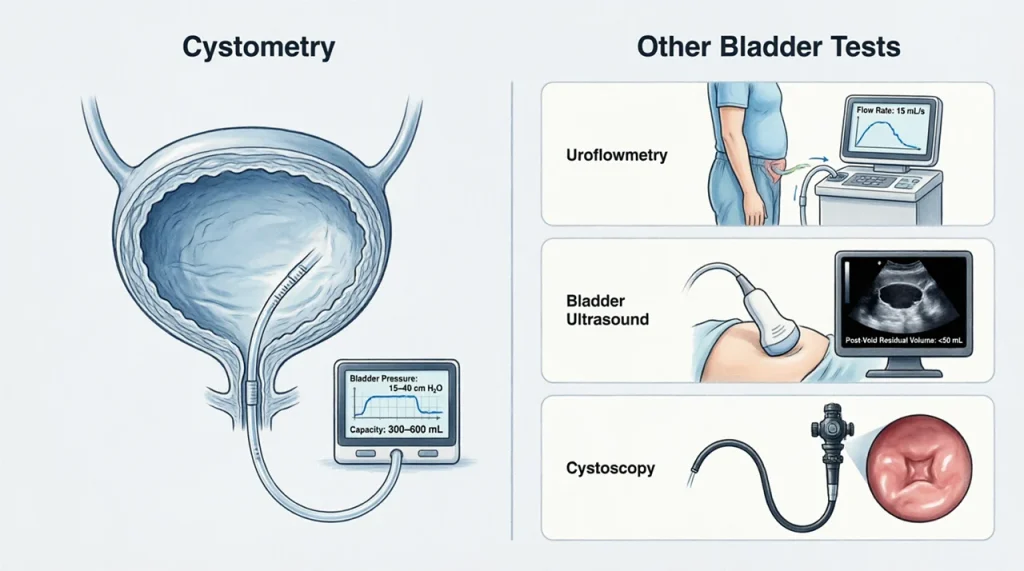
Each test answers a different question.
Uroflowmetry measures the speed and shape of the urine stream without bladder pressure catheters. Cystometry records pressure and sensation during filling, so it offers information a flow measurement alone cannot provide.
Cystoscopy uses a small camera to view the bladder lining and urethra. It looks for structural concerns; cystometry studies function.
Pressure-flow testing records pressure while you urinate and pairs it with urine flow. It focuses on emptying, while filling cystometry focuses on storage.
In selected complex cases, video urodynamics combines pressure recording with imaging.
Practical Questions Before and After Cystometry in Ajman
Most patients describe it as uncomfortable rather than painful. You will feel some pressure when the small catheter is placed, and a sense of urgency as the bladder fills, but nothing sharp or severe
Some medications do affect how the bladder behaves, so this is an important question to bring up beforehand. Dr. Jahanabadi will review your full medication list at your consultation.
In most cases, yes. Cystometry does not require sedation, so you are fully alert when it is done. Some patients feel mild discomfort or urgency for an hour or two afterward, so having someone with you on your first visit is a reasonable precaution, but it is not a requirement.
The test itself usually runs between 30 and 45 minutes. If additional measurements are added on the same visit, it can stretch to about an hour.
That pattern points toward stress urinary incontinence, and standard cystometry is designed to reproduce physical stress during the test to catch exactly that.
Dr. Jahanabadi reviews the tracings directly during and immediately after the procedure, so you will have an initial discussion the same day. A formal written report with treatment recommendations is typically ready within a few days.
Book a Consultation with a Female Urologist in Ajman, UAE
If cystometry has been recommended, book a consultation with Dr. Zahra Jahanabadi at Thumbay University Hospital in Ajman, UAE. My work focuses on female and functional urology.
I take time to understand your concerns and explain whether the test can help guide your care. Your privacy and comfort matter, and you can ask questions throughout your visit.
Bring your relevant medical records and a brief note about your symptoms. Contact the hospital to arrange your appointment and confirm the booking details. Cystometry requires an in-person visit.




You can submit the first comment for this post using the form above.