
Female Voiding Dysfunction Treatment in UAE | Specialist Care in Ajman

Female voiding dysfunction means your bladder takes longer than usual to empty and sometimes leaves urine behind. You might struggle to start passing urine and notice that the flow is weak or keeps stopping before you have finished.
Even after straining to empty your bladder, you could still feel a sense of fullness that sends you back to the toilet soon afterward. Some women also notice urine leaking when their bladder becomes too full.
About six in every 100 women over 40 have difficulty emptying their bladder properly. Some studies also suggest that a weak bladder muscle affects up to half of people seeking help for urinary symptoms unrelated to a nerve condition.
These problems are more common than many people realize and may have consequences when they continue over time. Urine left in the bladder can contribute to repeated urinary infections and bladder stones while pressure that builds up toward the kidneys can sometimes cause damage.
As a doctor I understand how bladder problems can affect your confidence and make your life stressful, and I encourage you to seek help so we can find the cause and discuss treatments.
Why UAE Women Struggle to Find Voiding Dysfunction Care
Female voiding dysfunction is one of the most underdiagnosed bladder conditions in the UAE. This is not because it is rare. It is because it is so often mistaken for something else entirely.
First Reason: You do not have to experience leaks to have this condition. Instead, you might notice a weak stream and need to strain while still feeling that urine is left behind.
These symptoms are sometimes put down to ageing or changes after childbirth rather than being investigated further.
Second Reason: voiding dysfunction is frequently mistaken for a urinary tract infection. Frequency and urgency along with that feeling of incomplete emptying can closely mimic infection.
Repeated antibiotics are unlikely to help when tests show no infection.
Third Reason: Similar symptoms can lead to a diagnosis of overactive bladder even when poor emptying is part of the problem.
A woman with an underactive bladder feels urgency because her bladder is chronically overfilled, not because it is overactive
The treatments for these two conditions go in opposite directions, which is why misdiagnosis makes things worse rather than better.
Fourth reason is access: Voiding dysfunction requires urodynamic testing to diagnose properly. Not every urology clinic in the UAE offers urodynamics. Not every urologist subspecializes in female voiding dysfunction specifically.
As an experienced female urologist in UAE, Ajman I can help you:
- Investigate difficulty emptying your bladder even if previous checks were normal
- Find out why urinary symptoms keep returning despite negative urine cultures
- Review your diagnosis if overactive bladder medication has not helped
- Identify the cause of your symptoms and find the right treatment
Obstruction vs. Underactivity: Two Reasons a Woman Cannot Empty Her Bladder
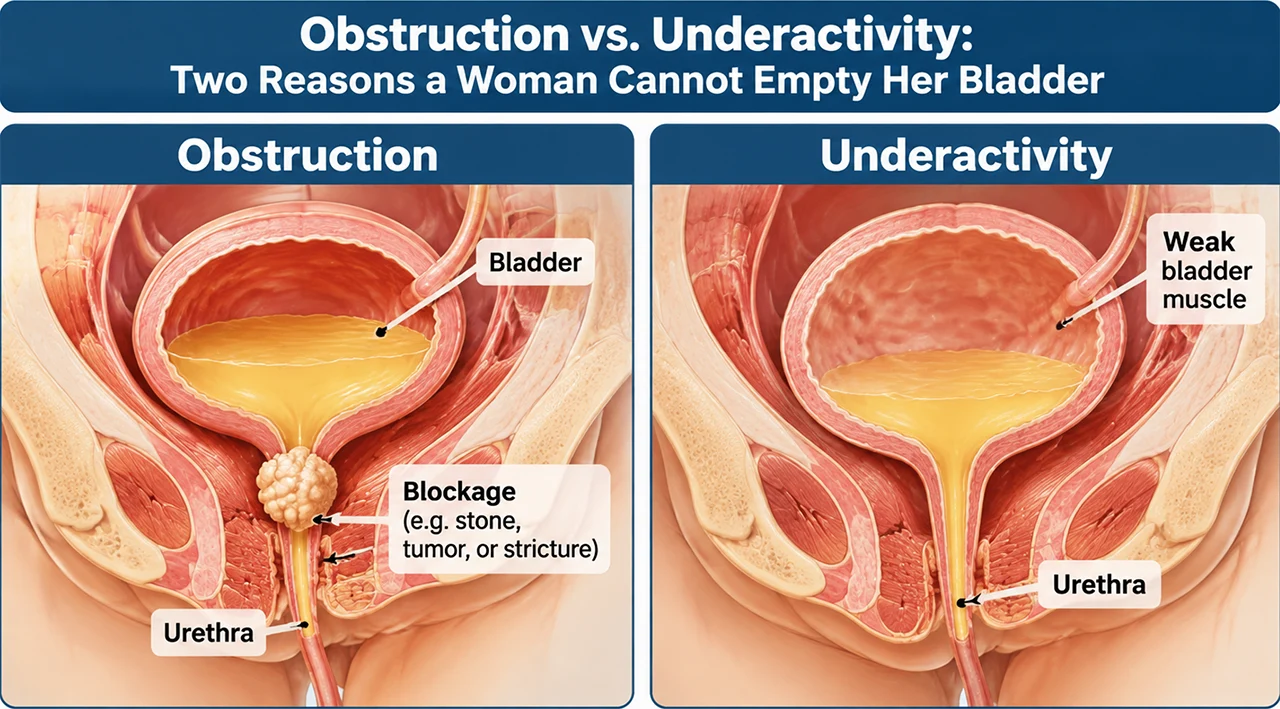
Your bladder muscle squeezes to push urine out while the opening relaxes to let it flow. Emptying becomes difficult when the opening does not relax enough or the bladder muscle cannot squeeze strongly enough.
Bladder outlet obstruction
Bladder outlet obstruction means urine has difficulty passing through the opening of the bladder. This can happen when pelvic organs drop out of place and press on the urine passage or when the passage itself becomes narrow.
Previous surgery to treat urine leakage can also make it harder for urine to flow.
Sometimes there is no physical narrowing but the muscles that control urine flow do not relax properly when you use the toilet.
Treatment depends on what is causing the resistance. Specialist pelvic floor therapy can help you learn to relax these muscles while a procedure is sometimes needed to correct a physical blockage.
Underactive bladder muscle
The detrusor is the muscle that squeezes your bladder to push urine out. When this muscle is underactive it does not squeeze strongly enough or for long enough to empty your bladder properly.
Certain medicines may contribute to this problem and conditions such as diabetes can affect how the bladder works.
A weak bladder and a blockage can feel similar so I will use a pressure-flow test to help tell them apart.
Some women have both problems at the same time. If this happens, I will explain which problem we should address first and how we will check whether treatment is helping.

How I Diagnose Female Voiding Dysfunction
Finding the cause of your bladder symptoms is important. I follow a step-by-step approach and recommend further tests when they are needed.
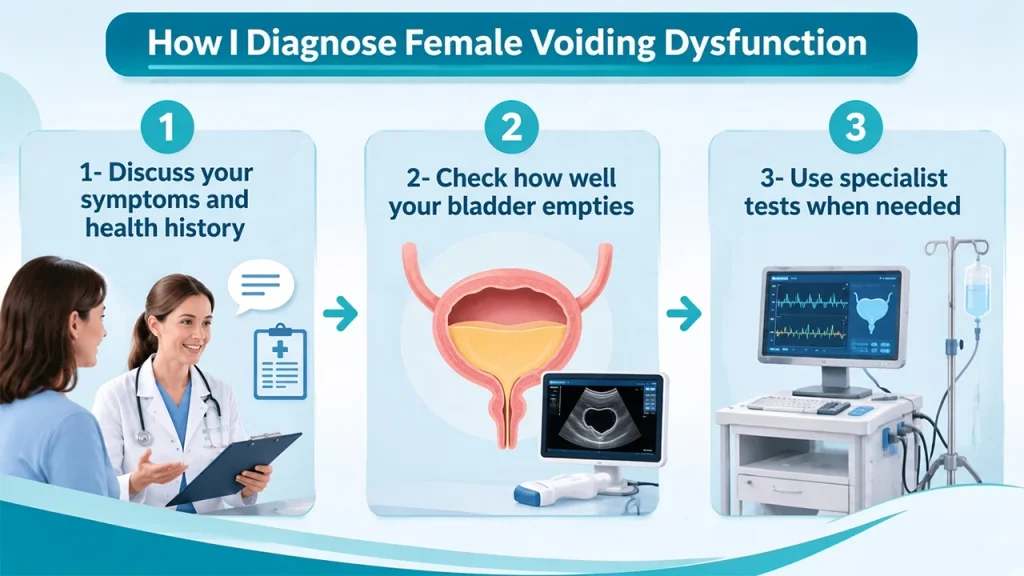
1- Discuss your symptoms and health history
I ask how your symptoms affect you and your life and review your medicines alongside any previous surgery. A pelvic examination helps identify physical problems while a urine test checks for signs of infection.
2- Check how well your bladder empties
A urine flow test measures the speed and pattern of your stream. An ultrasound scan then checks how much urine remains in your bladder after you finish.
3- Use specialist tests when needed
Urodynamic testing measures bladder pressure and urine flow to help distinguish a blockage from a weak bladder muscle. Additional imaging can show where a blockage occurs while muscle activity testing helps check whether the muscles controlling urine flow relax properly.
I interpret these results alongside your symptoms to explain what is happening and discuss the best treatment for you.
Treating Voiding Dysfunction Without Surgery
I usually start with the least invasive treatment. Depending on how well your bladder empties there are several options that may help without surgery.
Bladder habits and fluid guidance
Understanding how your bladder works can help. I guide you on when to empty your bladder and how to adjust your fluid intake to suit your needs.
Pelvic floor relaxation
If your pelvic floor muscles stay tense during urination the aim is to help them relax rather than strengthen them. Biofeedback uses sensors to help you recognize when these muscles are relaxing.
Help with emptying
If your bladder cannot empty safely on its own, I can teach you to use a thin tube called a catheter to drain it at planned intervals.
The schedule is based on how much urine your bladder holds and your individual needs.
Medicines for selected cases
Taking Medicines called alpha blockers can relax the muscles around the bladder opening to help urine pass more easily.
They are not suitable for everyone so we discuss the potential benefits and side effects before treatment.
Keep in mind that Treatment without surgery is an important part of care. I will help you understand which approach works best and check whether it is improving your bladder’s situation.
Advanced Treatment for Female Voiding Dysfunction in the UAE
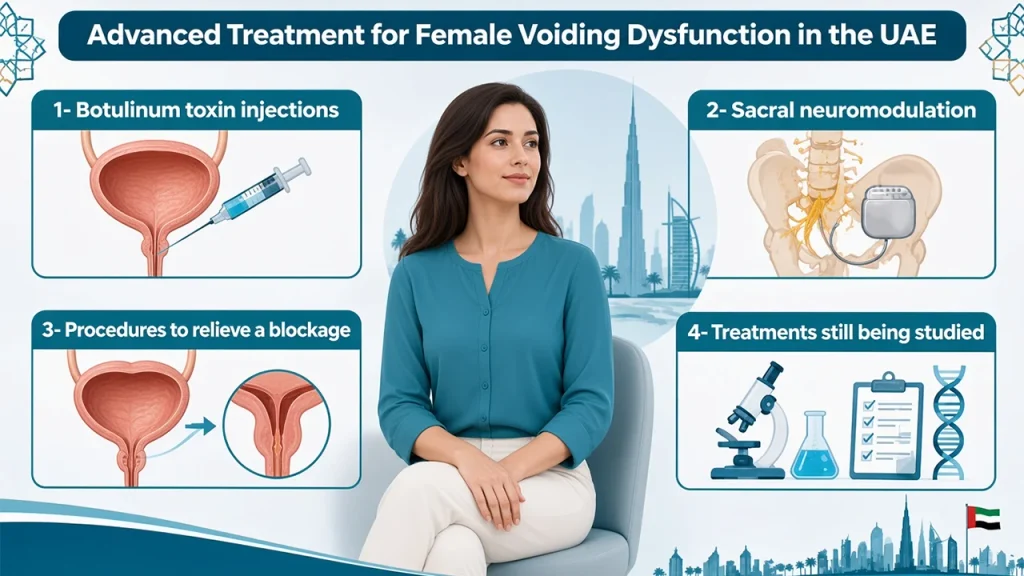
If initial treatment has not helped enough, I use your test results to guide the next step. Which might be one of the following options:
Botulinum toxin injections
An injection into the muscle that controls urine flow can help it relax in selected cases. This differs from bladder injections for overactive bladder and the evidence remains limited.
Benefits are temporary and urine leakage is a possible side effect.
Want to know more? Read About Bladder Botox Injection Treatment
Sacral neuromodulation
This treatment uses gentle electrical pulses to help the nerves involved in bladder control when poor emptying is not caused by a blockage.
A trial period checks whether it helps before a permanent device is considered. Ongoing follow-up is needed and device problems sometimes require another procedure.
Procedures to relieve a blockage
Treatment targets the confirmed cause of resistance. This could involve widening a narrowed urine passage or adjusting a previous sling that is restricting flow.
Treating pelvic organ prolapse can also help when it causes the blockage. Some procedures carry a risk of recurring narrowing or urine leakage.
Treatments still being studied
Electrical stimulation inside the bladder has not been shown to work reliably as routine treatment.
Shockwave therapy and treatments aimed at repairing bladder tissue also remain under investigation.
On the day of your appointment, I will explain the likely benefits and risks of each option.
Specialist for Female Voiding Dysfunction in UAE, Ajman
My clinical base is the Urology Center at Thumbay University Hospital in Al Jurf, Ajman. This is a tertiary-level urology service with full diagnostic and procedural capabilities, and it is where I see every patient who comes to me for female voiding dysfunction treatment in Ajman and beyond.
Women in Ajman choose this practice for clear reasons. The location is accessible. The specialist is female. The expertise is specifically in female and functional urology. The continuity of care means you see the same doctor from your first consultation through diagnosis, treatment, and long-term follow-up.
What many people do not realize is how far patients travel to reach this practice. Women come from Sharjah, from Dubai, from across the Northern Emirates, because specialist care for this specific condition is not uniformly available throughout the UAE. Ajman is not a limitation. It is the base from which I deliver UAE-wide specialist care for female voiding dysfunction.
Book a Consultation in Ajman
If you are looking for an experienced female urologist to help with female voiding dysfunction, we welcome you to the Urology Center at Thumbay University Hospital in Ajman. We care for women from across the UAE.
Your first visit is a chance to explain what has been troubling you and how treatment has worked so far. Together we will go through your medical history and plan any tests needed to understand the cause while keeping the process as comfortable as possible.
Please bring any previous urine test results and scan reports along with a list of your current medicines.
Contact the center directly to arrange your appointment and check whether a referral is needed.



You can submit the first comment for this post using the form above.