
Female Urethral Stricture Treatment UAE, Ajman | Dr. Zahra Jahanabadi

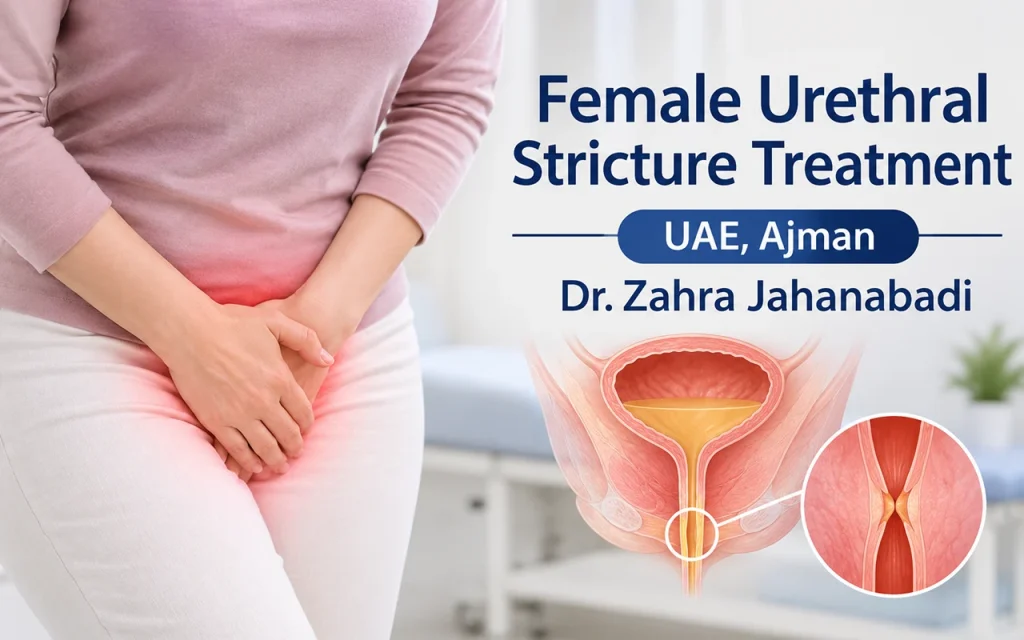
If you have been told over and over that your problem is a urinary infection, then an overactive bladder, then perhaps your hormones, and yet your bladder still does not feel properly empty, I want you to know that there is a real and identifiable condition that explains exactly this experience. It is called female urethral stricture, and specialist Female Urethral Stricture Treatment in the UAE is what I have devoted my practice to providing.
What Is a Female Urethral Stricture?
Female urethral stricture (FUS) develops when scar tissue narrows the channel that carries urine out of the body and makes it harder for the bladder to empty.
It affects roughly 1% of women with lower urinary tract symptoms and accounts for 4% to 13% of confirmed bladder outlet obstruction in women. Despite its impact on daily life the condition often goes unrecognized for years.
What Causes Female Urethral Stricture?
Scar tissue can form after injury or inflammation. Common causes include:
- Previous urinary catheter use
- Urethral procedures
- Pelvic surgery
- Repeated infections
- Long term irritation
- Pelvic trauma
- Previous treatment for urinary leakage
- Skin conditions that affect the genital area
- Radiation treatment
- Inflammation with no clear single cause
In some women the original cause is not obvious. That does not make the symptoms less real. A detailed history and the right urinary tests can still guide treatment.
When the Diagnosis for Female Urethral Stricture Has Been Missed for Years
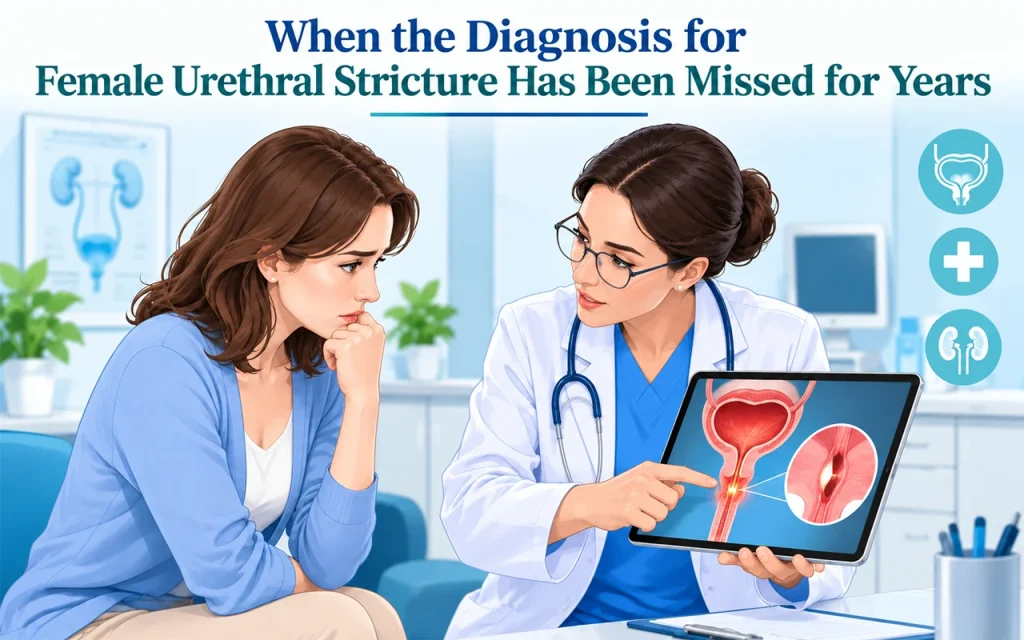
Women with Urethral Stricture often experience a mixture of storage and emptying symptoms. They can feel urgency and frequency while also having a weak stream or a sense of incomplete emptying.
This combination is one reason the condition is often labelled as a UTI or overactive bladder.
The diagnosis can take years. Published evidence describes an average delay of about 4.3 to 12 years. Some women wait as long as 30 years before the real cause is identified.
The cause is not always clear. In reported evidence the pattern is approximately:
- No clear cause found (Idiopathic): about 51.4%
- Related to previous medical treatment (Iatrogenic): about 38.3%
- Skin conditions such as lichen sclerosus: about 3.7%
- Radiotherapy: about 2.8%
- Inflammation: about 2.8%
- External trauma: about 0.93%
My role as a female urologist in UAE is to identify whether the urethra is narrowed. I also need to distinguish a fixed anatomical narrowing from a bladder muscle problem or a pelvic floor coordination problem.
Symptoms That Can Be Mistaken for Other Bladder Problems
Female urethral stricture can cause symptoms that resemble a urinary tract infection or an overactive bladder. This overlap helps explain why some women receive treatment for their symptoms without the underlying narrowing being recognized.
Reported symptoms include:
Frequent urination (63%): You find yourself going to the toilet more often than usual.
Urgency (55%): You feel a sudden need to pass urine that is difficult to put off. Although this is often associated with an overactive bladder it can also occur alongside a urethral narrowing.
Incomplete emptying (36%): You finish passing urine but still feel that some remains inside.
A narrowed urethra can prevent the bladder from emptying properly even when it contracts.
Poor urine flow (32%): Your stream becomes weak and passing urine takes longer than before.
This deserves attention rather than being dismissed as a normal part of ageing.
Urinary leakage (31%): Leakage can have several causes including urethral stricture.
Straining to pass urine (21.5%): You need to push to start urinating or keep the stream going.
Repeated urinary tract infections (20.5%): Urine left behind after each visit to the toilet can encourage bacterial growth and contribute to recurring infections.
Waking at night to urinate (20.5%): Incomplete emptying can contribute to repeated night-time toilet visits although other conditions can cause this too.
Burning or discomfort when passing urine (20%): This can feel like an infection but symptoms alone cannot confirm the cause.

Symptoms Among Women Who Needed Reconstructive Surgery
In the surgical group described in the research the reported symptoms were:
- Poor urine flow: 91.6%
- Straining to pass urine: 82.2%
- Incomplete emptying: 72%
- Frequent urination: 71%
- Urgency: 59.8%
If you have a weak stream or difficulty emptying alongside a frequent need to urinate it is worth having the cause investigated. These symptoms do not prove that you have a stricture but they deserve a closer look rather than repeated antibiotics without evidence of infection.
Diagnosing Female Urethral Stricture in the UAE, Ajman
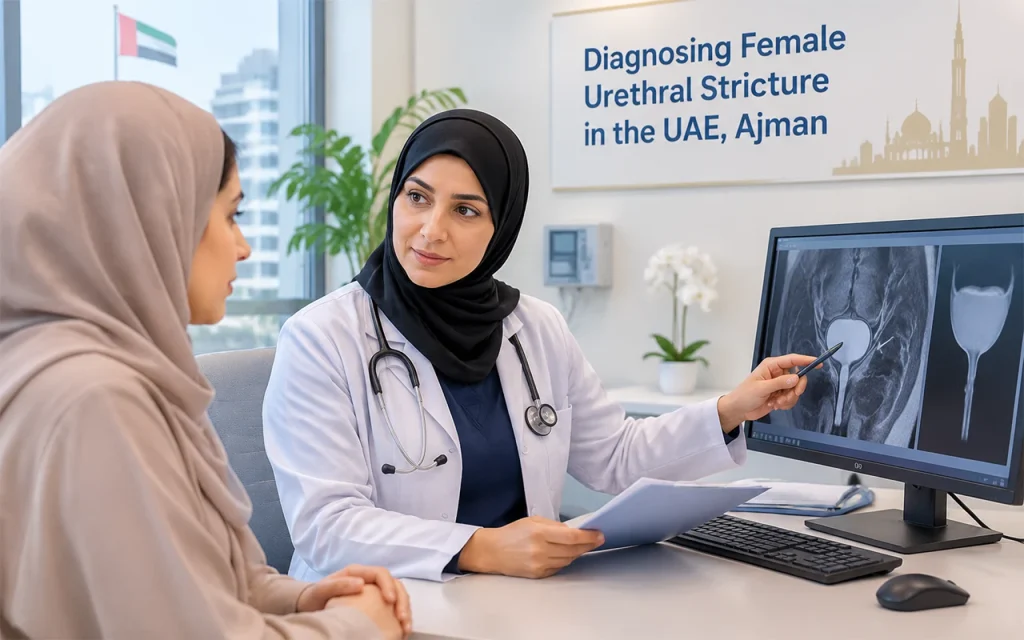
I begin by listening to your symptoms and discussing your medical history to understand what could be affecting urine flow. A gentle pelvic examination then helps check for visible narrowing and other possible causes with your privacy respected throughout.
Depending on your symptoms I recommend tests such as:
- Uroflowmetry: Measures the speed and pattern of your urine flow to check for signs of obstruction.
- Post-void residual measurement: Checks how much urine remains in your bladder after you finish urinating.
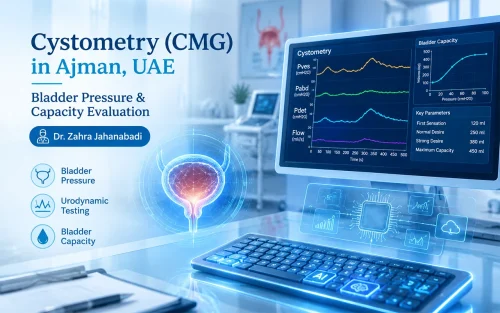
- Video urodynamics: Examines how your bladder empties to help distinguish a physical narrowing from a problem with how the muscles work.
- Cystourethroscopy: Uses a thin viewing instrument to look inside your urethra and bladder.
- MRI: Provides additional detail when another underlying problem is suspected.
You do not need every test to reach a diagnosis. I choose investigations based on your situation.
Read more: Urodynamic testing and bladder diagnostics
Urethral Dilation: What It Can and Cannot Achieve
Dilation is a reasonable first treatment for an uncomplicated female urethral stricture because it is minimally invasive and has a low complication rate.
It gently stretches the narrowed area to help urine pass more easily.
What Dilation Can Do
Dilation can improve your urine flow and help your bladder empty more fully which can also ease urgency. Some women maintain this improvement with intermittent self-dilation to help keep the urethra open.
What Dilation Cannot Do
Dilation does not remove the scar tissue so it cannot guarantee a lasting result. Across four studies involving 183 women the proportion whose urethra stayed open after dilation alone ranged from 7.5% to 51%.
Once the stricture returns repeated dilation alone is unlikely to provide a permanent solution.
Urethroplasty and the Reconstructive treatment Option
Urethroplasty is an operation that rebuilds the narrowed section of your urethra to create a wider channel. It offers a more lasting approach when dilation has not provided lasting relief or self-dilation becomes painful and difficult to manage.
The repair uses healthy tissue taken from inside the cheek or suitable vaginal tissue depending on the position and extent of the narrowing.
How Successful Is It?
Published rates of the urethra remaining open after surgery range from:
- 83% to 93% for ventral repairs performed along the underside of the urethra
- 73% to 93% for dorsal repairs performed along the upper side
These results are encouraging but do not guarantee that every urinary symptom will disappear. Follow-up remains important to check your recovery and ensure the channel stays open.
Urethroplasty involves surgical risks and a recovery period so the decision needs careful discussion.
Meatal Strictures: A Distinct Problem with a Distinct Solution
Not every narrowing is the same, and the location of the problem determines the right operation. A meatal stricture is a narrowing at the external urethral opening itself, the very tip of the channel, distinct from a stricture within the urethral canal.
It produces similar complaints of spraying, weakness of stream, and incomplete emptying, yet it calls for a different surgical answer.
Two procedures exist for this situation:
- Meatotomy: a small surgical enlargement of the meatus, suitable for short distal narrowing’s.
- Meatoplasty: a formal reconstruction of the opening, which published data show to be highly successful, with patency of 96% at twelve months in the largest pediatric series and resolution of recurrent infections in 48 of 50 patients.
Why does this matter to you? Because meatal strictures are frequently overlooked during a general examination. When I examine a patient in my Ajman, UAE for urethral stricture, the meatus is always examined deliberately, because treating the wrong level of the urethra guarantees disappointment.
Common Questions About Female Urethral Stricture Treatment UAE

Yes. It is estimated to affect about 1% of women with lower urinary tract symptoms. It is underdiagnosed because the symptoms overlap with UTI. Overactive bladder. Functional voiding problems. Many women wait years for the correct diagnosis.
Childbirth can contribute to urethral injury or scarring in some women. Symptoms that begin after delivery still deserve a proper examination because weak flow is not always caused by pelvic floor changes.
A slower stream can be an early warning sign. Taking longer to urinate or feeling full after passing urine also deserves review before the narrowing becomes severe.
Recovery differs according to the repair and your general health. Most patients need a period of restricted activity followed by gradual return to normal routines under specialist guidance.

Book Your Consultation: A UAE-Wide Service
If you have a weak stream or repeated urinary symptoms then it is reasonable to ask whether the urethra has been checked. If you have received several UTI treatments without lasting improvement then a specialist review can provide a clearer direction.
I am Dr. Zahra Jahanabadi and I am a Consultant Urologist with more than 18 years of experience in female and functional urology.
If you are struggling with symptoms of urethral stricture, I will take the time to listen to your concerns and investigate what is causing them so we can reach a clear diagnosis. I will explain your treatment options and guide you through your care.




You can submit the first comment for this post using the form above.