


So many women live quietly with a vaginal bulge or a constant, nagging feeling of pressure in the pelvis. Others notice a heaviness that won’t go away, urinary changes, or the frustrating difficulty of emptying the bladder or bowel completely. They carry it silently—sometimes for years—because they aren’t sure who to talk to, or they assume nothing can really be done.
As a female urologist, I’ve seen firsthand how deeply prolapse can disrupt everyday life. It makes exercise uncomfortable. It chips away at intimacy and confidence. Even the simplest activities—picking up your child, sitting through a work meeting, going for a walk—can start to feel stressful.
My aim here is straightforward: help you understand what’s actually happening in your body, and then walk you through the right treatment options.
Understanding Pelvic Organ Prolapse
Organ prolapse occurs when the muscles and tissues that support your pelvic organs become weak or stretched over time. This support system includes the endopelvic fascia along with important ligaments such as the uterosacral ligaments. When that natural scaffolding loses its strength, the bladder, uterus, rectum, or small bowel can drift downward, pressing against the walls of the vagina. Doctors call this pelvic organ descent.
There are a few things I think every woman in Ajman should know about this condition:
1. Prolapse is genuinely common
Many women experience some degree of pelvic organ prolapse during their lifetime. The risk climbs after vaginal childbirth, and ageing, hormonal shifts, and repeated strain on the pelvic floor all play a role too.
2. It’s rarely dangerous—but it still matters
Pelvic organ prolapse is not usually life-threatening, yet it can quietly erode your comfort and emotional wellbeing. Some women notice problems with bladder or bowel control; others find that intimacy and confidence take a real hit. You deserve better than “just live with it.”
3. You do not have to accept it as part of ageing
Yes, prolapse is often linked with childbirth or menopause, but that doesn’t mean the symptoms are yours to endure indefinitely. Many women stay silent because they feel embarrassed or assume nothing can be done.
Treatment is available, and your care plan will be chosen after a thorough assessment and how much support your pelvic organs actually need.
4. Your symptoms deserve attention, regardless of stage
The stage of prolapse is only one piece of the picture—your comfort and quality of life matter just as much. I’ve seen mild prolapse cause significant distress in one woman while advanced prolapse barely bothers another.
Treatment, whether that’s physiotherapy, a pessary, or in more advanced cases reconstructive surgery, should be based on how the prolapse affects you specifically.
One of the most common things I hear in my clinic is, “Doctor, I thought I was the only one.” You’re not.
Pelvic organ prolapse is a treatable condition, and you don’t have to manage it without support.
Types of Pelvic Organ Prolapse
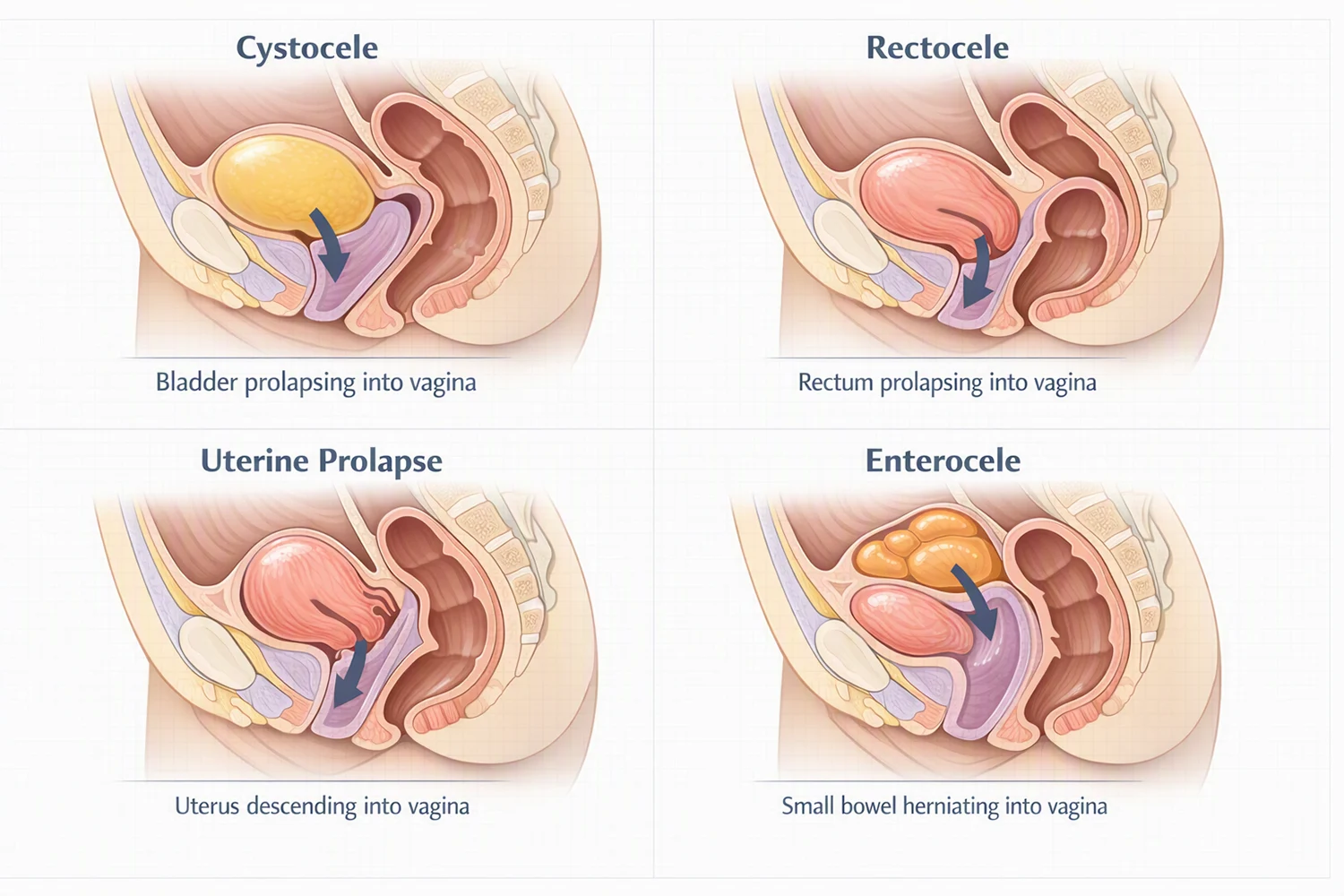
Every woman’s prolapse looks a little different, and honestly, that’s part of why individualized care matters so much. Here are the most common types I see in practice:
- Cystocele (bladder prolapse): The bladder drops into the vagina, causing pressure and sometimes making it difficult to empty the bladder completely.
- Rectocele (rectal prolapse): The rectum bulges into the back wall of the vagina, often leading to straining and a sense of incomplete bowel emptying.
- Uterine prolapse: The uterus descends into the vaginal canal—more common, naturally, in women who haven’t had a hysterectomy.
- Vaginal vault prolapse: The top of the vagina collapses after a hysterectomy.
- Enterocele: The small intestine bulges into the vaginal space.
Many women have more than one type at the same time, which is why I always map the exact type and severity before recommending any treatment.
What Causes Pelvic Organ Prolapse?
Prolapse rarely comes from one single event. Pressures tend to stack across years until the pelvic supports finally give way.
These are the patterns I see most often:
- Vaginal childbirth
- Extra body weight
- Chronic constipation
- A lingering cough
- Heavy lifting and high-impact activity
- Family history
- Earlier pelvic surgery
How Pelvic Organ Prolapse Is Diagnosed?
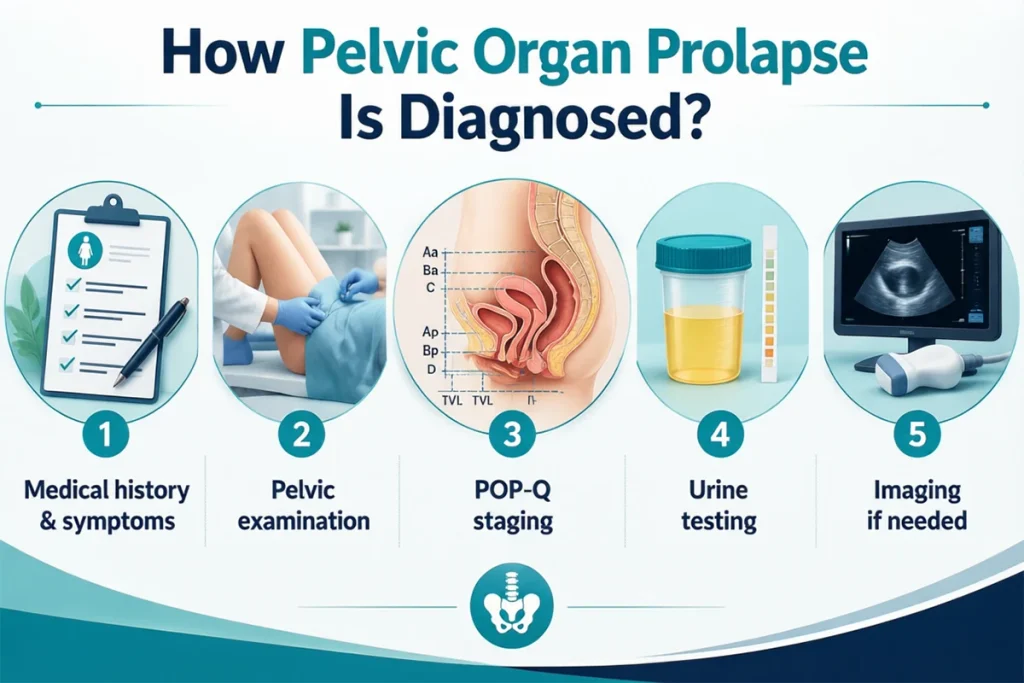
Diagnosis starts with a careful conversation and a pelvic examination. I first ask about your symptoms and your medical history, and I usually want to know about:
- Childbirth history
- Menopause status
- Constipation patterns
- Coughing (chronic or seasonal)
- Urine leakage
- Bowel symptoms
- Sexual concerns
- Past surgeries
- How the problem affects your daily life
POP-Q staging is the standard system used to measure prolapse:
- Stage 0: No prolapse
- Stage I: Prolapse stays well above the vaginal opening
- Stage II: Prolapse reaches near the opening
- Stage III: Prolapse extends beyond the opening but not completely
- Stage IV: The vagina is fully turned inside out
This staging helps show how advanced the prolapse is, but remember—it’s only one part of the picture.
Other tests may be needed depending on your symptoms.
Urodynamic testing is useful if there’s urine leakage or trouble emptying the bladder, and cystoscopy may be recommended if bladder symptoms or recurrent infections need a closer look.
Non-Surgical Treatment for Pelvic Organ Prolapse in Ajman
Surgery isn’t necessary for every woman with pelvic organ prolapse. Many of my patients achieve genuine relief through conservative care, and the right approach depends on the type of prolapse, its severity, and how much it disrupts your day-to-day life.
Here are the non-surgical options I work with:
Pelvic floor muscle training

A supervised program of at least four months strengthens the muscles supporting your bladder, uterus, vagina, and rectum. It’s particularly helpful for mild-to-moderate prolapse, for women hoping to delay surgery, or for those managing other pelvic floor issues alongside prolapse.
Vaginal pessary
A removable device fitted inside the vagina to hold prolapsed organs in place and ease that bulging, pressure sensation.
It suits women who want relief without an operation, need support during exercise or travel, want time before deciding on surgery, or prefer a long-term non-surgical option.
With regular reviews and proper care, a pessary can serve as a lasting solution—not just a stopgap.
Lifestyle modifications
These matter more than most people realize. Targeted changes include:
- weight loss to reduce abdominal strain
- treating constipation to stop repetitive straining
- quitting smoking or managing chronic cough (each bout pressures the pelvic floor)
- cutting back on heavy lifting
- getting proper medical care for asthma or any persistent cough
Vaginal estrogen
After menopause, vaginal tissues often become dry, thin, and delicate. Topical estrogen restores local comfort and tissue health in suitable patients, especially when dryness or irritation is part of the picture.
Newer Treatments
- magnetic stimulation
- electrical therapy
- energy-based treatments
These are sometimes discussed in selected cases, but only after a thorough assessment. They don’t replace a pelvic examination or individualized medical advice, and I’d never recommend them as a first-line option without proper evaluation.
Surgical Treatment for Pelvic Organ Prolapse in Ajman
We really only consider operating when the prolapse is actively getting in the way of your life, or when conservative methods just didn’t cut it. I care way more about your daily comfort and personal goals than what “stage” a medical chart says you’re in.
Minimally Invasive and Vaginal Repairs
If the top of the vagina has dropped, I usually lean toward a laparoscopic or robotic approach. We use tiny incisions to anchor the tissues securely, which gives you durable support and a much smoother recovery.
For bladder or rectal bulges, a standard vaginal repair simply tightens those weakened walls directly through the natural opening.
Keeping Your Options Open
You don’t automatically lose your uterus during prolapse surgery. If keeping it matters to you, we can just suspend it back into its proper place. On the flip side, for women who no longer want penetrative intercourse, narrowing the vaginal canal offers a highly effective, lower-impact fix.
Finally, since fixing a major bulge sometimes unmasks a hidden urine leak, we can easily tuck a quick anti-incontinence sling into the same operation if we need to. Everything is entirely tailored to what your body actually needs.
Choosing the Right Treatment
There is no single operation or treatment that suits every woman. The right choice should reflect the location of the prolapse, the severity of your symptoms, your daily activities, and your future plans.
Important considerations include:
- Avoiding or delaying surgery, if possible
- Preserving the uterus
- Planning a future pregnancy
- How important vaginal intercourse is to you
- Bladder or bowel symptoms
Sacrocolpopexy, for example, is an effective option for suitable women who need durable support at the top of the vagina.

Book Your Consultation
You’ve read this far for a reason. Whether your symptoms are new or something you’ve quietly carried for years, relief begins with one private, respectful consultation.
Speak with Dr. Zahra Jahanabadi at Thumbay University Hospital in Al Jurf, Ajman. As a female urologist, Dr. Jahanabadi provides discreet, personalised care ranging from conservative treatment to advanced pelvic floor surgery.





You can submit the first comment for this post using the form above.